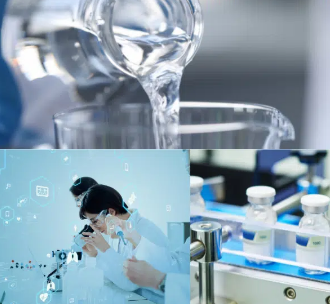

This solution brings treatment to water meeting GMP-WHO standard, helps saving energy, ensures stable operation.
In the pharmaceutical industry, clean water is a widely-used raw material in pharmaceutical manufacturing and plays a decisive role for the quality and safety of each product. Therefore, in every pharmaceutical manufacturer, the water treatment system for manufacturing activities must be strictly managed, ensuring simultaneous factors: quality, stable operation.

Why Water Treatment Is Essential in Pharmaceutical Manufacturing
Water is a vital component in the pharmaceutical industry. It is not only used as an ingredient in formulations but also for cleaning equipment, preparing solutions, and sterilizing tools. However, raw water sources often contain impurities that can compromise product quality and safety.
Common Water Sources
-
Groundwater: Often rich in dissolved minerals like calcium, magnesium, and manganese.
-
Municipal Water Supply: While cleaner, still may not meet pharmaceutical-grade standards without additional purification.
To meet regulatory standards and ensure consistent product quality, all input water must undergo a thorough purification process.
Pharmaceutical-Grade Water Standards (GMP-WHO)
Water used in pharmaceutical applications must comply with Good Manufacturing Practices (GMP) and World Health Organization (WHO) guidelines. Key parameters include:
| Parameter | Limit / Standard | Unit |
|---|---|---|
| pH (25°C) | 5.2–7.0 (WHO) | – |
| Taste | Tasteless (per Vietnamese Pharmacopeia) | – |
| Calcium & Magnesium | 0 ppm | ppm |
| Color | None (Pt-Co scale) | – |
| Chloride | ≤ 0.5 (WHO) | ppm |
| Sulfates | No color change after 1 hour | – |
| Oxidants | No color change after 5 minutes | – |
| Ammonium | ≤ 0.2 (Ph.Eur) | ppm |
| Nitrate | ≤ 0.2 (WHO) | ppm |
| Aluminum | ≤ 0.01 (Ph.Eur) | ppm |
| Heavy Metals | ≤ 1.0 (Ph.Eur) | ppm |
| Evaporation Residue | ≤ 0.001 | % |
| Conductivity (25°C) | ≤ 1.3 (Water for Injection) | mS/cm |
Types of Water Used in the Pharmaceutical Industry
Water for pharmaceutical use is generally categorized into four main types:
-
Utility Water: Tap water used in non-critical areas like bathrooms or gardens.
-
Soft/Demineralized Water: Partially treated to remove hardness and some ions; used in boilers and for equipment rinsing.
-
Purified Water: Free from microbial contaminants and toxins, used in non-injectable preparations.
-
Distilled Water / WFI (Water for Injection): Highly purified and sterile; essential for injectable solutions.
What to Consider When Choosing a Water Treatment System
Pharmaceutical companies must assess the following factors when designing or investing in a water treatment plant:
-
Water Purity Requirements: Based on production needs (e.g., sterile vs non-sterile products).
-
Ease of Operation & Maintenance: Systems should be user-friendly and cost-effective.
-
System Certification & Validation: Must meet GMP and other regulatory requirements.
-
Economic Viability: Evaluate long-term costs including utilities, manpower, and maintenance.
-
Input Water Quality: Conduct a thorough water quality survey to tailor the treatment process.
Toptech Enterprise’s Water Treatment Solutions for Pharma
Toptech Enterprise provides advanced water treatment solutions that meet GMP-WHO standards. Our systems are:
-
Energy-Efficient: Reduced power consumption
-
Safe & Durable: Made from food-grade materials
-
Environmentally Friendly: Reuses concentrate water to reduce waste
-
Precision-Engineered: Custom-built to ensure optimal membrane life and consistent performance
Example: GMP-Compliant Water Treatment Process
Here is a general outline of the treatment stages:
1. Pre-Treatment (Multi-Media Filtration)
Removes suspended particles, chlorine, and organic matter using graded filters and activated carbon. Controls turbidity (SDI ≤ 5) and protects RO membranes.
2. Double-Stage RO System
Uses high-pressure membranes to eliminate 95–99% of ions, bacteria, and viruses. It includes:
-
Pre-filters and pumps
-
RO membranes (Phase I & II)
-
Post-RO safety filters
3. Demineralization (EDI)
Removes dissolved salts (sodium, calcium, chloride, etc.) through ion-exchange or electric deionization. Delivers high-purity water (resistivity up to 18.2 MΩ).
4. Chemical Cleaning System
Includes chemical storage tanks, dosing pumps, and agitators. Used periodically to clean and regenerate the RO membranes.
5. Automation & Control
Fully automatic PLC systems manage operation, monitor quality, and reduce human error.
Applications of Pharmaceutical Water Treatment
-
Formulation & Blending
-
Sterile Injection Preparation
-
Equipment Cleaning & Sterilization
-
Rinsing Syringes, Vials, and Eye-drop Bottles
-
Autoclave Feed Water